AI can generate almost anything. Which makes knowing what you actually want more important than ever.
The real challenge isn’t always the technology. It’s the clarity of thought behind it.
Understanding the problem. Defining the outcome. Communicating intent. Recognising when something works — and when it doesn’t.
AI is remarkably good at generating answers. That doesn’t necessarily mean we’re getting better at asking questions.
The real shift isn’t simply learning how to use AI. It’s learning how to think, articulate intentions and make decisions in a world where creating things has become dramatically easier.
AI can explore possibilities, challenge assumptions and accelerate execution. But it shouldn’t quietly become the one making all the important decisions.
Let AI do theheavy lifting.Keep the thinking.
03 / The thinking
Technologyis the easypart.
Well, not always.
But understanding the actual problem is usually more interesting than choosing the technology to solve it.
Q1Why does this process still involve six spreadsheets?
Q2Why are people transferring information between systems by hand?
Q3And do we really need another software subscription?
Good questions tend to lead to better solutions.
I combine analysis, creative thinking and hands-on engineering to understand how things work today — and how they could work better tomorrow.
Sometimes the answer is AI. Sometimes it’s custom software. Occasionally, it’s simply doing fewer unnecessary things. I’m quite fond of that last one.
Data doesn’t become useful just because someone put it into a dashboard.
I explore how AI can help structure information, identify patterns, support analysis and make complex datasets easier to work with.
The interesting part isn’t generating more numbers. It’s asking better questions of the ones we already have.
Responsible AI.
Powerful technology deserves thoughtful use.
Privacy, information security, transparency and human oversight aren’t obstacles to innovation. They’re part of making innovation sustainable.
I help businesses approach AI with an understanding of its capabilities, limitations and risks. Because being able to do something isn’t always a good reason to do it.
06 / Fashion & AIExperience, not a sales pitch
4:5Image 001 — still empty
The imageis only thebeginning.
Fashion has always been about creativity, precision and visual storytelling. Generative AI adds an entirely new dimension.
My professional work has included helping establish AI-powered image generation within a commercial fashion environment, connecting technology with creative production workflows.
What interests me most isn’t simply the ability to generate an image. It’s the shift in thinking behind it.
01How do we describe creative intent?
02How do we maintain visual consistency?
03How do we make new technologies useful to the people working with them?
The real transformation happens when technology becomes part of a thoughtfully designed process.
07 / Explorations3 / current
Some ideassolve problems.Others createnew questions.
Both are worth exploring.
I like building things, testing ideas and seeing what happens when different technologies meet. Some experiments are practical. Others are creative. A few began with the simple question: What if?
No fictional client success stories. Just ideas, experiments and things I’ve actually built.
A collection of prompts, tools, experiments and useful things. Not because the internet needs another collection of 500 AI prompts. But because a few well-designed tools can make a real difference.
L01In preparation
The Clarity Check
A simple way to turn a vague idea into a structured brief. Define what you want, what matters and how you’ll recognise a good result. Because sometimes the best prompt begins before you open an AI tool.
L02In preparation
The Prompt Library
Thoughtfully designed prompts for business, analysis, creative work and software development — with context, inputs, limitations and copy-ready outputs. Less trial and error. More intentional results.
L03In preparation
AI Reality Check
Where could AI genuinely help your organisation? Practical discovery questions for a small business: a starting point for exploring opportunities, limitations and next steps.
L04In preparation
Tools & experiments
Small utilities, interactive prototypes and things from my digital workbench. Some might save you time. Others might just make you curious.
No registration obstacle course. Just useful things.
Some ideas begin with a client brief. Others begin with curiosity, a strange visual concept or a question that probably didn’t need answering.
My generative art explores fashion, identity, visual storytelling and the creative possibilities of AI. For me, art is another form of experimentation — a place to question conventions, explore aesthetics and discover possibilities without having to justify every creative decision with a spreadsheet.
Designer by education.Developer by experience.Creative Technologist by choice.
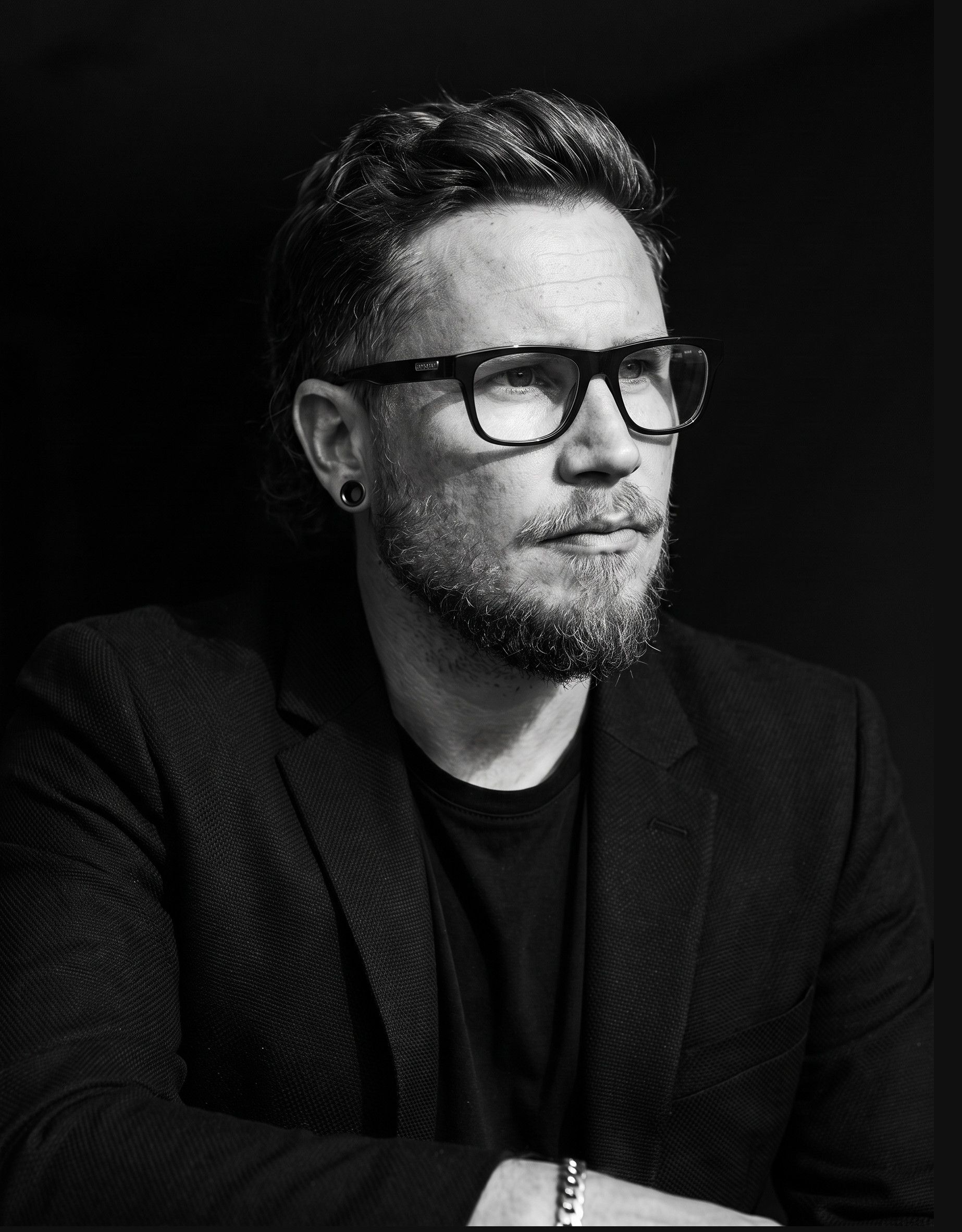
I studied Media Design at Bauhaus University Weimar and have been working independently through OM1 MEDIA since 2002.
Over the years, I’ve developed digital products, built web applications, consulted businesses and led software development teams. More recently, my work has focused on generative AI, AI-driven business processes and software development with AI.
Different technologies. Different challenges. The same fascination with understanding how things work — and how they could work better.
I enjoy good questions, elegant solutions, creative experiments and people who aren’t afraid to challenge the obvious. I also believe technology should be understandable, useful and, ideally, a little fun.
A process that takes too much time. An idea for something that doesn’t exist yet. Or the suspicion that AI might be useful, if only you knew where to start.
Tell me what you’re working on. We might find a straightforward solution. We might discover something more ambitious. Either way, a good conversation is a good place to start.